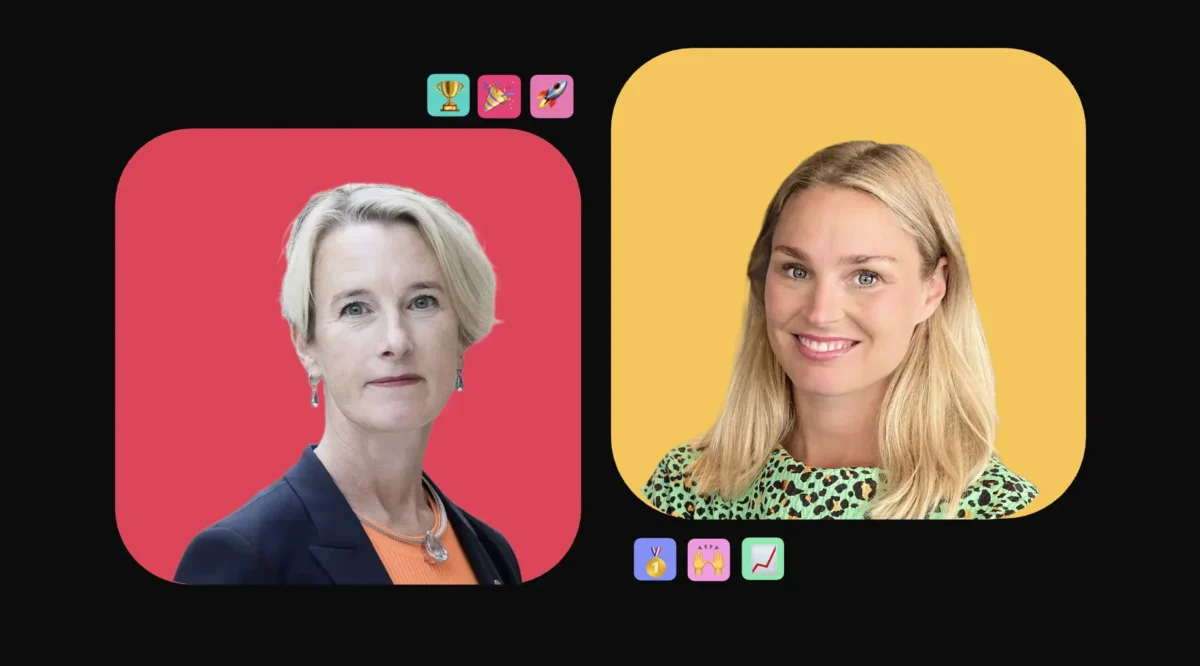

Welcome to the podcast Nå mål with me, Sophie Hedestad. I am CEO of Noxit and work to help organisations create clear direction and real results. I am joined by Viveka Beckeman, CEO of Skogsindustrierna, an exciting member organisation. How does Viveka balance the interests of the members while also driving internal goals forward? How does she connect long-term perspectives to what employees actually do in their day-to-day work?
The perspectives in this podcast also build on the ideas in the book Riktning och resultat.
Welcome to Nå mål, Viveka, tell us about yourself. Who is Viveka?
Thank you! As you can probably hear from my accent, I am from Scania and have been a Stockholmer since 1998. For the past five years, I have been the CEO of Skogsindustrierna.
Tell us about your journey, from growing up in Scania to Stockholm. How did you end up at Skogsindustrierna? I want to know more, what did you study and what does your experience look like?
I grew up in Åstorp in northwestern Scania, right next to a forest. For me, the forest was a playground, but it was not something I ever imagined I would one day work with. My journey went through law studies in Lund, which I found incredibly enjoyable. I moved to Stockholm in 1998 and have done many classic legal jobs. I have served in district court, worked in the court of appeal, worked at a law firm and held various management positions.
When I entered the forest industry when I became chief legal counsel at a forestry company and also had a few other roles there. I like working with change and with issues where you can actually make a difference. The forest industry is exactly that kind of industry. Here, you can work with issues that truly matter. We are a driving force in the green transition, and through the forest industry you can influence the society we live in. I think that is exciting, and that is why I am here. What I do now is an incredibly exciting role, because I get to work in an industry I am passionate about together with fantastically committed people. I feel that we are truly creating progress.
Your background as a lawyer, how does that help you in your role as CEO?
A legal education is very broad. One of its great advantages is that you gain insight into many different industries, and that has enabled me to bring experience from other sectors into this job. As a lawyer, you are also trained to absorb large amounts of information, sort it and turn it into something concrete. That is very useful to me as a CEO. We live in a rapidly changing world, and those of us who work with political advocacy have a lot happening around us all the time. The ability to make things concrete and set goals for a business is something I truly bring with me.
We talked a little about political advocacy, but could you tell us about Skogsindustrierna? Why do you exist? How do you work? Who are your members, who are your employees & who are you?
We are an industry organisation that works with political advocacy and with increasing the value of wood raw materials. We represent companies across the entire forest value chain. Our members are active in sawmills, paper and pulp, and also in businesses that manufacture textiles. The common denominator is companies that refine Swedish forest raw materials. We are present throughout the country, from small family-owned companies to large international groups. There is a broad range among the member companies.
There are around 45 of us working at Skogsindustrierna. We have experts in standardisation, business policy, communication and other specialist areas. What unites both our employees and the people working at the member companies is a tremendous commitment to the industry. These are people who go to work because they genuinely believe that what we do matters. I enjoy working with committed people, and that is why I think Skogsindustrierna is a fantastic workplace.
Workplace and political advocacy, then you are going to help the members reach their goals. But what is it that you need to influence? Which politicians are we talking about?
Political advocacy is a central part of our work at Skogsindustrierna. Yes, we are lobbyists, even though that word has almost become a little charged in Sweden. Our job is to influence politicians and decision-makers on issues that are important for our member companies. One example is the EU Deforestation Regulation. The basic idea is good: that European consumption should not contribute to deforestation in the world. But there was also a proposal for a regulatory framework that would become extremely administratively burdensome.
In principle, it would be possible to follow every small part of the raw material through a very complex value chain, from a tree in the forest to the finished product. That would create a great deal of administration and bureaucracy for companies. Our job, then, is to help politicians understand reality and to show how the same goals can be achieved in a more efficient way. The Swedish economy is highly dependent on export companies. Our companies manufacture a great deal in Sweden and sell on a global market. To remain competitive, they need to be cost-effective, and regulatory hassle can become a major problem. That is why it is important that we help decision-makers understand how their decisions affect companies in practice.
And we are also going to talk about goals. What is your relationship to goals?
I think goals are an important tool, but above all, the right goals are an important tool. Early in my career I worked at a law firm, and there was a culture where the focus was very much on billable hours. That was also the only thing that was measured. In an environment where people already work a great deal and also enjoy working, it can easily become an unhealthy culture if the only thing you manage toward is more hours. Then there is a risk that quantity takes precedence over quality, and I believe that is counterproductive. For me, it became an early example that goals in themselves are not always good. It is about finding the right goals.
You work to achieve the members goals and at the same time, as CEO, you are responsible for setting the direction for the teams and employees. How does that balance work?
The most important thing for us is that things work out as well as possible for the member companies. At the same time, in our daily work we need to set goals that are clearly linked to that. An important tool that we developed just over three years ago is what we call the Future Agenda. It emerged at a time when the green transition was very much in focus. We felt that other industrial sectors were getting a great deal of attention in the discussion, which was good, but we also saw that our own industry had long been built on fossil-free raw materials and fossil-free processes.
We wanted both to create increased political interest in our industry and at the same time keep energy and direction high internally. That is why we launched a future journey where we set goals for how we ourselves wanted to create progress. It was a major effort, because this is not something we in the Stockholm office can do by ourselves. The real work happens out at the member companies.
That is why we devoted a great deal of time to anchoring both the vision and the direction. We landed on two clear main tracks: to continue driving the green transition and to ensure that politicians continue to create the right conditions for our industry. It needed to be visionary and forward-leaning, but at the same time realistic. The work of setting the goals took more than a year. In the end, we landed on three clear goals: that our products should be completely fossil-free and renewable by 2040, that we should reduce our climate impact by 30 percent, and that forests should be richer in biodiversity.
Under these, there are also a number of sub-goals. It was an ambitious effort, but also very concrete. I am proud that together we managed to develop it, and we use it both in our dialogue with politicians and when we set goals for our own organisation.
So the Future Agenda still applies?
Yes, it still applies.
So 2040 is the year you are working toward?
2040 is our long-term direction, but we have also developed action plans with milestones along the way. You cannot set a goal for 2040 and then simply hand it over to the future. If you want to create real progress, it takes time, especially in an industry with long cycles. That is why you need both direction and concrete steps along the way.
So that is the direction, and then you set milestones based on it? How do you steer the organisation toward this, do you work with annual goals or three-year business plans? What happens next?
At Skogsindustrierna we work with milestones. If you take one concrete example, part of the goal of reducing climate impact is that our land transports should become completely fossil-free by 2040. That is a very big challenge and requires major investments from the member companies. That is why we have set milestones along the way and follow up on how far we have come.
You are around 45 employees and have different departments. How do you get this out into the organisation? Do the departments set their own goals, activities or how is it rolled out?
The departments set their own goals and activities linked to the overall goals. That is also why it was so important that the goals were well anchored with the member companies, because in practice it is they who make the investments, for example in electric trucks or biofuels. It is out there that the real change takes place. Our job is to help ensure that legislation and political decisions make it easier to reach the goals.
If we take transport as an example, it is about charging infrastructure, investments in biofuels and other conditions that need to be in place. Our action plans therefore include both milestones and clear activities around what we ourselves need to do and what we need from politics.
You said it took a year to put the Future Agenda together, and I can imagine you had many discussions. You said it needed to be stretched but still realistic and achievable. How do you deal with it when someone in the group disagrees or is not engaged? How do you move forward then?
During that year, it was very much about letting vision meet reality. When I started painting the picture of where I thought we needed to land for it to be sufficiently visionary and forward-leaning, I was met with quite a lot of resistance. We had to solve that through discussion. The option of not being part of the journey did not really exist, because I thought, and still think, that this is such an important shift for the industry.
At the same time, the goals have to be possible to anchor. There were many good conversations where vision and reality were allowed to meet. Some goals were adjusted downward because they were not realistic, while those who were most sceptical at the beginning also shifted their positions. It was a very good process in which we tried to understand each other better.
Goals are not entirely easy. When you evaluate the milestones, it may be that the goals were too ambitious, that performance was not sufficient or that something happened in the external environment. How do you know when you are doing a good job?
I think that is the hardest part in our type of business. Of course, all industries are affected by the external environment, but when you work with political advocacy it becomes especially clear. When we developed the Future Agenda, there was a very strong focus on the green transition. Since then, the world has changed. We have had more wars, a deeper recession, trade policy conflicts and tougher global competition. All of that affects companies’ ability and willingness to make major investments.
That is why it is an advantage to have long-term goals. Then you can tolerate some bumps in the road, as long as the direction remains fixed. The important thing is to continue taking the steps that are possible. For us, it is sometimes difficult to determine whether we have succeeded or not, because we may have done very good work while at the same time the outside world made it impossible for the conditions to be there. Then you need to be able to take a step back and analyse whether you could have done something differently or whether it was actually the circumstances that set the limits. And sometimes you also need to be prepared to revise goals when reality changes too much.
Let us say you miss a goal and agree that it is about your own performance. How do you handle that?
The most important thing is that you learn something from it. We need to analyse why we did not reach the goal and focus on what we could have done differently. I do not believe very much in pointing fingers. On the other hand, I do believe that you need a climate where you can say: I did not do this well, I need to do this better next time. That applies both to me as a leader and to the rest of the organisation. I think it is better to set high goals and sometimes not go all the way than to set goals so cautiously that you do reach them, without creating enough progress.
It is not entirely easy, and there is something often called the whirlwind, this thing about firefighting, urgent issues and everything that happens in everyday life. How do you balance this, working with goals and progress when at the same time it is firefighting all day long?
That is a very big challenge. We have incredibly committed employees who do many good things every day, but a great deal is also happening all the time. Political pressure is high and the economic environment is changing rapidly, so it is easy to get stuck in the here and now. That is why I think it is important, at regular intervals, to stop and evaluate what you are actually spending your time on.
Are we working in a way that helps us reach long-term goals, or are we just getting stuck in the whirlwind? If the answer is that you are stuck, then sometimes you need to dare to say that certain things should stop being done. It is not only about having fewer meetings, but about understanding why you are doing what you are doing and whether it is actually moving the organisation forward. Quite simply, sometimes you need to stop and ask whether the work actually supports the long-term direction.
Do you have a success story about goals that you can share?
Yes, I know I have talked a lot about transport and the Future Agenda in Skogsindustrierna, but for me that is actually one of our clearest successes. When I first spoke to the group working on transport and said that I envisioned a future commitment of completely fossil-free transport, I was met with strong reactions. They basically said: do you understand how expensive this is? It involves enormous investments. But a year later, it was precisely that group that set the most ambitious goals of all.
By then, they had understood how the agenda could become a tool in the collective work and why it mattered. For me, that is a success story: when a goal goes from feeling impossible to becoming something that engages those who are actually going to help implement it.
That is where strategy comes to life. Is there any personal goal that you are focusing on yourself?
Yes, since I am 50 plus, I may have the same goal as many others my age: I am going to exercise more. My first goal is to exercise a little more regularly. I run quite a lot, especially during the summer months, but I want to find a routine that lasts all year and also do more strength training.
I am also working on my French. Right now I use Duolingo, and there my goal works quite well because there is a clear element of gamification. I also have a goal of learning to play the piano, but there I probably have to admit that progress is going quite slowly.
It is still impressive with both language and instrument training. That is a lot to fit in.
Yes, we are working on it. I cannot say that I have reached the goal yet.
Not yet, no. Thank you so much, Viveka, for joining Nå mål.
Thank you, it was great to be here.